
 Posts
Posts


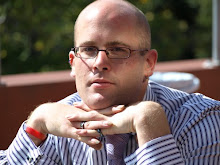
This year didn't quite turn out the way I thought it would. Serving on the OUSA executive as the inaugural Queer Rep altered my plans dramatically. Yet this alteration actually worked in my favour rather than against me. Since the job took up much more of my time than I was anticipating and I was having problems with the programme's administration, I decided to temporarily withdraw from my studies. This year's executive service not only helped me to act upon the beliefs I was researching in my MA but it also gave me better insight into serving something bigger than myself - a vital aspect of directing.
A further aspect of time is that it lets things "percolate" for a while. I think I started my MA because it was the logical continuation of my undergrad work. Yet, this is not enough of an incentive to undertaking PG study. After thinking for a while - and having started a Diploma in Adult Education and Training through SIT - I now have much more direction in what I am actually wanting to achieve with tertiary study. Although I still fervently believe that one goes to university to learn, that is learning for learning's sake, rather than to get a job. I guess it is only natural that this fascination with learning should lead me to investigating how the process actually happens. I have known for a while that I was aiming for a career in the academy but now I have more focus on how to actually achieve that goal. Indeed, my MA in Theatre Studies is a vital means to the end I desire.
Smell the Roses: Take Some Time Out!
A Semester of Actor Training
This semester, I took the opportunity to take THEA454: Advanced Actor Training. This was originally intendend to supplement my Master's study but I have since decided to take some time out from my MA. This course focused on the Meisner technique and - although I felt there were some problems with the course/assessment design and objectives - gave an interesting appraisal of the technique. It is not my point here to talk much about details of the technique itself - that will be the detail of another post - but rather to make some general comments.
My main problem with the Meisner technique is that it does not account for the intention of a production. Although it can help the actors out in the heat of performance, it negates their autonomy in creating a performance. Indeed, it relies on the actor's removing their conscious control - yet it is this control which makes us who we are. If we are to deny control of ourselves then how are we to be true to our "selves"? For a person who is excluded from fully participating in society - due to race, religion, sexuality, gender identity, class etc - then the technique has the potential to uphold the social-control mechanisms that have served to subject these "alternative" identities to juridical control. Surely it is the place of theatre to question hegemonies rather than uphold the process upon which those hegemonies are predicated. At least I feel that is theatre's moral duty.
MA Proposal
A Proposal for Master of Arts in Theatre Studies
University of Otago
Neal Barber
Background
During my Directed Project, I found that traditional ways of creating theatre were not affective for creating queer theatre. To begin with, the process needed to be more personal in nature; it needed to take more account of how the people involved related to the issues the production tried to stage. One of the reasons that this failed in my Directed Project is that we were too focussed on mounting a show; we needed to trust in the rehearsal process and ourselves. That is, we let the fact we had to put on a show take over from experimenting with the process we could use to create that show. We had a further problem in that the process we used was a "traditional" one - we got onto the stage with our scripts and hoped something would happen. Whilst this can be effective, and something generally does happen, we need to create a structure for this to happen. My MA project will aim to devise a structure in which "something might happen." This objective focusses on the process rather than the results since we have only the general destination production.
I will be contextualising my praxis with what how other performance groups have handled the rehearsal process and staging queer theatre in particular. To this end, I will be researching the history of gay/queer theatre generally. I will look at these specific groups in the context of contemporary theatre praxis in America, England, Australia, and New Zealand.
This practical exploration will be grounded in theoretical research. This research will not only provide a form of road map to help navigate me - and my actors when I come to the practical component - but it will also provide the theoretical framework on which I can structure the project; theoretical research will provide both the structure and context for performance.
Theorists
Post-Structuralism/Semiotics
Baudrillard, Derrida, Foucault,
Queer Theory
Butler, Halperin, Kosofsky Sedgwick,
Performance Theory
Carlson, Pavis, Schechner
Practice Theory
Bogart, Stafford-Clark(Joint Stock), Taymor
Queer Performance
Dolan, Román, Savran
Structure
This project will break neatly into three stages. The first stage "Background Reading" encompasses the background research for the project. This stage will propose a methodology - informed by theory - that will then be tested in the second stage: "Case Study." My case study will involve using actors to test out the methodology that I propose in the first stage and adapting it as necessary. This project necessarily requires some form of "workshop" but it is still unclear whether this workshop will lead to a performance although I would like this to be the case. The case study will generate data I will then analyse in the "Analysis." This process is summarised in a table below.
Case Study
This will, obviously, be the hardest part of the my project. However, I have been thinking of one of the ways that I will work around this possible problem area. Firstly, I am eager not to rush into this case study without proper planning. As I suggested before, this planning will come out of the "Background Reading" phase of my project; this phase will generate the framework which we will use to investigate creating theatre. I will, however, be requiring a group of actors who are eager to undertake a workshop type exercise. In this workshop, the group will explore the concepts we find relevant to performing queer aesthetics as well as creating a praxis for that performance.
Simply finding actors willing to participate may be a challenge. There may be a problem finding people who are willing to provide their time to such a project and I will need to find people who are actually committed to the aims of our workshop. To this end, I have brainstormed with my supervisor and Stuart Young - Head of Theatre Studies Programme - and we have some names of more mature actors around town we could shoulder-tap. These people have the advantage that they will bring a more professional attitude to the workshop and - if I use students - they will set the tone for students to follow.
| Stage | 1) Background Reading | 2) Case Study | 3) Analysis |
| Key Outputs | Literature Review Methodology Personal Statement | Performance Reflective Journal | Thesis |
| Research Paradigm | Traditional "Research" | Reflective Practice -Reflection in Action | Reflective Practice -Reflection on Action |
| Motivating Question/s | Is there such a thing as a queer aesthetic? If so what does it look like? What methodological approach best suits this project? How have other practitioners attempted to create personally motivated theatre? | How do we create a production that accounts for this research? How do we create queer theatre that is personally motivated? How do we merge live and digitised performance | |
| Research Areas | Queer Theory Performance Theory Practitioner Theory | The process of directing/rehearsing | Analysing data gathered in the Case Study Synthesising these data with the theoretical framework established in Stage 1 |

"Anne Bogart 2001," American Theatre, vol. 18, no. 6, pp. 34-5. Retrieved 30 Sep 2008, from Academic Search Complete database.
Baudrillard, J 1981, For a critique of the political economy of the sign, Telos Press, St. Louis MO.
Baudrillard, J 2001, 'Simulacra and Simulations', in M Poster (ed.), Selected Writings, Stanford University Press, Standford, CA, pp. 169-87.
Blumenthal, E & Taymor, J 1999, Julie Taymor : Playing with Fire : Theater, Opera, Film, H.N. Abrams ; in association with the Wexner Center for the Arts, New York.
Bogart, A 2001, A Director Prepares : Seven Essays on Art and Theatre, Routledge, London New York, NY.
Bogart, A 2007, And Then, You Act : Making Art in an Unpredictable World, Routledge, London New York.
Bogart, A & Landau, T 2004, The Viewpoints Book : A Practical Guide to Viewpoints and Composition, New York Theatre Communications Group St. Paul, MN.
Butler, J 1999, 'Bodily Inscriptions, Performative Subversions', in J Price, and Shildrick, Margrit (ed.), Feminist Theory and the Body: A Reader, Edinburgh University Press, Edinburgh, pp. 416-22.
Butler, J 2003, 'Critically Queer', in E Striff (ed.), Performance Studies, Palgrave Macmillan, Basingstoke, Hampshire, pp. 187-99.
Butler, J 2006, Gender Trouble: Feminism and the Subversion of Identity, Routledge, New York.
Butler, J 2007, 'Performative Acts and Gender Construction: An Essay in Phenomenology and Feminist Theory', in H Bial (ed.), Performance Studies Reader, 2nd edn, Routledge, Abingdon, Oxon, pp. 187-99.
Carlson, D 2001, 'Gay, Queer, and Cyborg: the Performance of Identity in a Transglobal Age', Discourse: Studies in the Cultural Politics of Education, vol. 22, no. 3, pp. 297-309. Retrieved 16 Sep 2008, from
Casey, C 2006, 'Panic in The Project: Critical Queer Studies and the Matthew Shepard Murder', Law and Literature, vol. 18, no. 2, p. 225. Retrieved 21 April 2008, from Proquest 5000 database.
Coen, S 1995, 'The Body is the Source: Four Actors Explore the Rigors of Working with Master Teachers Anne Bogart and Tadashi Suzuki', American Theatre, pp. 30-76. Retrieved 30 Sep 2008, from General OneFile database.
Cohen, E 1991, 'Who Are 'We'? Gay 'Identity' as Political (E)motion (A Theoretical Rumination)', in D Fuss (ed.), Inside/Out, Routledge, NY, pp. 71-92.
Corral, WH, and Daphne Patai 2005, 'Identities: Introduction', in Theory's Empire, Columbia University Press, New York, pp. 397-9.
Crouch, KA 2003, Shared Experience Theatre: Exploring the Boundaries of Performance, Dissertation Thesis, Ohio State University. Retrieved 02 Oct 2008, from http://www.ohiolink.edu/etd/view.cgi?acc_num=osu1054738772.
Dyer, R 1991, 'Believing in Fairies: The Author and The Homosexual', in D Fuss (ed.), Inside/Out, Routledge, NY, pp. 185-201.
Dyer, R 2002, The Culture of Queers, Routledge, London.
Edelman, L 1991, 'Seeing Things: Representation, the Scene of Surveillance, and the Spectacle of Gay Male Sex', in D Fuss (ed.), Inside/Out, Routledge, NY, pp. 93-116.
Fenton, D 2007, ''Unstable Acts': A Practicioner's Case STudy of the Poetics of Postdramatic Theatre and Intermediality.'
Fleche, A 1995, 'When a Door Is a Jar, or out in the Theatre: Tennessee Williams and Queer Space', Theatre Journal, vol. 47, no. 2, pp. 253-67. Retrieved 21 April 2008, from JStor database.
Foucault, M 1978, The History of Sexuality, Pantheon, New York.
Halperin, D 1997, Saint Foucault: Towards a Gay Hagiography, Oxford University Press, New York.
Haring-Smith, T 2003, 'Dramaturging Non-Realism: Creating a New Vocabulary', Theatre Topics, vol. 13, no. 1, pp. 45-54. Retrieved 30 September 2008, from Project Muse database.
Haseman, B 2005, 'Card Sharps: Playing our Creativity', in Backing Our Creativity: National Symposium on Education and the Arts, Victorian College of the Arts, Melbourne, Australia, 14 September.
Herrington, J 2000, 'Directing with Viewpoints', Theatre Topics, vol. 10, no. 2, pp. 155-68. Retrieved 30 Sep 2008, from Project Muse Premium Collection database.
Hovde, E, Meyer, M, Taymor, J, Jillette, P & Teller. 1992, Behind the Scenes with Julie Taymor, Distributed by Contemporary Arts Media, Australia.
Jagose, A 1996-1997, 'Queer Theory', Austalian Humanities Review, vol. 4. Retrieved 26 May 2008, from
Koepping, K-P 1985, 'Absurdity and Hidden Truth: Cunning Intelligence and Grotesque Body Images as Manifestations of The Trickster', History of Religions, vol. 24, no. 3, pp. 191-914. Retrieved 8 Aug 2008, from JSTOR database.
Lampe, E 1992, 'From the Battle to the Gift: The Directing of Anne Bogart', TDR, vol. 36, no. 1, pp. 14-47. Retrieved 30 Sep 2008, from JSTOR database.
Mahanti, M 2005, 'Judith Butler', in RK Phil Hubbard, and Gill Valentine (ed.), Key Thinkers on Space and Place, Sage London, pp. 65-71.
McNiff, J, and Jack Whitehead 2006, All You Need to Know about Action Research, Sage London.
Parker, AaEKS 2007, 'Introduction to Performativity and Performance', in H Bial (ed.), Performance Studies Reader, Routledge, Abingdon, Oxon, pp. 200-7.
Pavis, P 1982, Languages of the Stage : Essays in the Semiology of the Theatre, Performing Arts Journal Publications, New York N.Y.
Pavis, P 1992, Theatre at the Crossroads of Culture, Routledge, London New York.
Pavis, P (ed.) 1996, The Intercultural Performance Reader, Routledge, London New York.
Pavis, P 2003, Analyzing Performance : Theater, Dance, and Film, University of Michigan Press, Ann Arbor.
Pavis, P 2008, 'On Faithfulness: The Difficulties Experience by the Text/Performance Couple', Theatre Research International, vol. 33, no. 2, pp. 117-26. Retrieved 30 Sep 2008, from Cambridge Journals on-Line database.
Pryor, J 2006, 'Passing/Out in Texas', Theatre Topics, vol. 16, pp. 65-84.
Risner, D 2002, 'Rehearsing Heterosexuality: Unspoken Thruths in Dance Education', Dance Research Journal, vol. 34, no. 2, pp. 63-78. Retrieved 16 Sep 2008, from ProQuest 5000 database.
Savran, D 1995, 'Ambivalence, Utopia, and a Queer Sort of Materialism: How" Angels in America" Reconstructs the Nation', Theatre Journal, vol. 47, no. 2, pp. 207-27.
Savran, D 2003, A queer sort of materialism : recontextualizing American theater, University of Michigan Press, Ann Arbor.
Scheie, T 2000, 'Performing Degree Zero: Barthes, Body, Theatre', Theatre Journal, vol. 52, pp. 161-81. Retrieved 19 Sep 2008, from Project Muse database.
Sedgwick, EK 1990, Epistemology of the Closet, University of California Press, Berkely.
Seigel, L 2005, 'Queer Theory, Literature, and the Sexualization of Everything: The Gay Science', in WH Corrall, and Patai, Daphne (ed.), Theory's Empire, Columbia University Press, New York, pp. 424-41.
Shewey, D 2002, 'Theatre of the Queer', Gay & Lesbian Review Worldwide, vol. 9, no. 6, p. 11. Academic Search Complete database.
Taylor, D 1998, 'Tim Miller's My Queer Body: Performance Of Desire', Journal of Medical Humanities, vol. 19, no. 2/3, pp. 225-34. Retrieved 21 April 2008, from Academic Search Complete database.
Tyler, C-A 1991, 'Boys Will Be Girls: The Politics of Gay Drag', in D Fuss (ed.), Inside/Out, Routledge, NY, pp. 32-70.
Washington, GE 2006, 'Performance Art as a Site for Learning: Queer Theory and Performance Studies in the Art Classroom', The Journal of Social Theory in Art Education, no. 26, p. 195. Retrieved 21 April 2008, from Proquest 5000 database.
Young, CW, 'C W Young Responds to Annamarie Jagose', Australian Humanities REview. Retrieved 26 May 2008.
Inhabit My Space
I have been reading Anne Bogart's And Then, You Act ostensibly as preparation for my MA but also because it is actually rather good. However, tonight I came across the following passage:
"If you supply a complete world with all the details, then the audience has nothing to do but accept the illusion and become passive" (76).
This comes from the chapter entitled “Magnetism” which examines how fantastic theatre contains empathy, entertainment, ritual, participation, spectacle, education, and alchemy.
This quote resonated with me whilst giving me some approval. I have realised that I usually provide very few of the details. My sets are usually sparse – particularly those for The Maids and The Winter's Tale – which allows the audience to exercise their imaginations to put their own localities onto the sets which they see.
This view of theatre also hints at a way to create productions using queer theory. Since the queer is often a space in the text – the space which is inhabited by those things which it is not polite or too dangerous to talk about – we can use this space on the stage. By dropping some hints that allow the audience to read queer in a production, we can stage things which some members of the audience may not normally be willing to confront. In this way we can subtly work against homophobia in the world rather than challenging it openly and thereby inciting resistance in the audience.
Risk
I have been quite astounded by the actors' willingness to explore homoeroticism in Winter's Tale. In previous productions, many of my actors have just not wanted to take the risk. Not only are my actors taking more risks but I think I have been too cautious in the past. Particularly when I directed ShaxxxQueer. I have found that if you ask the actors to do something they will probably do it – there is no need to pussy-foot around gay stagings.